

"Flowers are my canvas."
Luisa Valeria Estrada Rivera, known artistically as Luisa de la Rosa, is a Mexican artist whose work is born from a radical gesture: translating the language of nature into art that resists its oblivion.
Her practice lies at the intersection of the emotional, the botanical, and the eternal, transforming real flowers and plants into acts of memory and homage.
Coming from a family steeped in artistic sensibility—the niece of renowned artists Juan Manuel, Damián, and Raúl de la Rosa, as well as graphic designer Óscar Estrada—she grew up surrounded by creative stimuli that awakened her inclination toward art and aesthetic contemplation from an early age. Although those who knew her and watched her grow up believed she would pursue an artistic path, having excelled in it since childhood, she pursued another area of interest: business. She earned a degree in Business Administration from Tecnológico de Monterrey, while continuing to develop and practice art in various forms.

Largely self-taught, she has explored disciplines such as painting, music, graphic design, acting, modeling, and photography, among others. However, it was in 2020 that she found her distinctive path: she founded Votanical Floral Atelier, where she began experimenting with dried flowers as her primary medium. With technical rigor and emotional sensitivity, she developed her own professional conservation technique that allows her to maintain the shape, color, and anatomy of flowers, defying the passage of time.
Since I was a child, flowers have been my language, my refuge.
AND MY WAY OF SEEING THE WORLD.
For me, they are the physical symbol of an emotional moment. When they wither, they represent the end of a cycle, decline, and impermanence. But instead of accepting that stage as it is, I decided to intervene artistically to transform them into art that would prevail.
AND SO, THEY WOULDN'T DIE... IN MY WAY."

Over the course of five years of her professional career, she has created more than 200 artworks, nationally and internationally, telling intimate stories through emotional botany. Her technique has been shared with more than 50 students in Mexico and abroad, and she even taught classes at her alma mater, Tec Campus Monterrey. Her work has resonated with those seeking to preserve significant moments in a unique piece of art. It has brought her opportunities to exhibit her work at the Metropolitan Museum of Monterrey and cultural centers such as Casa COA, donate the sales of her paintings to charities, and even design pieces for public figures.
Living with a spinal condition has prevented her from pursuing her practice in a linear way. However, she has responded with determination and creativity, adapting her method to her physical abilities and turning adversity into an essential part of her artistic narrative.
Art has also been a way of emotional healing. Through her practice, she has channeled moments of anxiety, grief, transformation, and reconnection with her personal history. Therefore, Luisa promotes art as a tool for emotional well-being and mental health, especially in contexts where silence, sentimentality, femininity, and even art have been minimized. In 2024, she had an experience that would redefine her outlook on life, and she translated it into her artistic expression, which led her to innovate her collection:

“And your boat did have to leave”
My altar, offering and testimony of an eternal connection.
The inaugural work of a technique born of mourning, memory, and eternal love. This piece preserves authentic flowers: the first one my grandfather gave to my grandmother, in a park when she was fifteen, and the gladiolas that bid him farewell at his memorial. Of the two gladiolas, one represents him, and the other me. United forever, in a sober and sacred composition, guided by the music that united us while I made it. That music always reminds me of him and my grandmother, dancing together, in their favorite place.
Created in a process of intimate mourning, listening to 'La Barca', this work embodies the promise that what is loved never completely disappears: it becomes art.
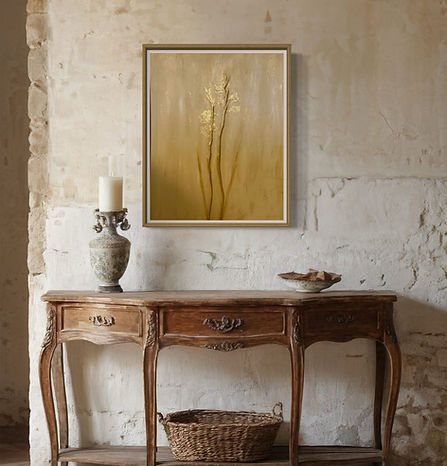
She decided to put her administrative career on hold to dedicate herself to being a full-time artist, due to the high demand for artwork requests. This would also allow her to focus on a lifestyle that prioritizes her health.
Committed to her continued development, in 2025 she decided to merge her two passions—art and business—in New York, enrolling in complementary courses at the Sotheby's Institute of Art. This step marks a new chapter in her career, reaffirming her vision of professionalizing her practice and positioning her work internationally.
Starting that year, Luisa adopted the stage name "de la Rosa," a tribute to her family lineage and an affirmation of her identity as an artist. In a country where art exists but is rarely valued; where the sensitive is hidden and the feminine is relegated, Luisa makes this a movement to express through the gesture of conserving nature, as a form of resistance.
Her art doesn't just seek to be seen: it seeks to be remembered. It invites the viewer into emotional introspection, to engage with what hurts and flourishes at the same time, and to listen to the silent language of nature.
In each work, the elegance of the organic becomes a symbol of permanence within the temporal, to dress spaces with sentimental symbols that accompany our journey.